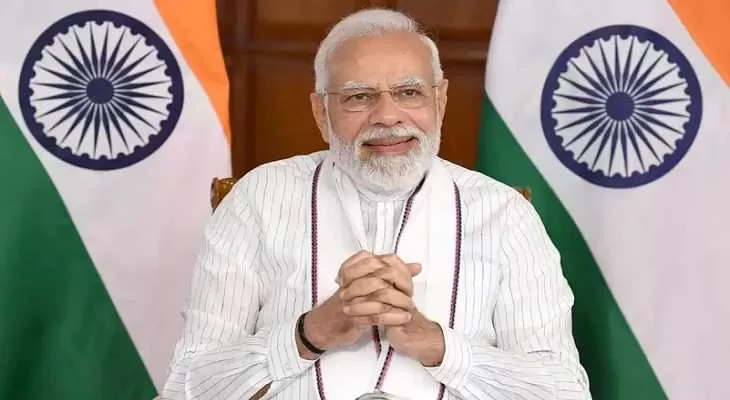

Modi Ji’s full name is Narendra Damodardas Modi and he was born on September 17, 1950, in Vadnagar, a small town in Mehsana district Gujarat. He was the third of six children in a modest family. His father Damodardas Modi, ran a tea stall at the Vadnagar railway station, and young Narendra helped him by selling tea to passengers. Despite financial constraints, his parents emphasized the value of education and hard work.
At the age of eight Modi was introduced to the Rashtriya Swayamsevak Sangh (RSS), a Hindu nationalist organisation. His association with the RSS deepened over the years and in 1971, he became a full-time pracharak (campaigner) for the organization in Gujarat. During the 1975-77 Emergency imposed by then Prime Minister Indira Gandhi, Modi went underground to evade arrest and continued his political activities. He also authored a book, Sangharsh Ma Gujarat (Gujarat in Emergency) detailing his experiences during that period.
In 1985, Modi ji started their political journey from Bharatiya Janata Party (BJP) and the decision came from RSS. He quickly rose through the party ranks serving in various systematic roles By 1995 he was appointed as the BJP's National Secretary controlling the party's activities in several states.
In 2001, Modi was appointed as the Chief Minister of Gujarat, succeeding Keshubhai Patel. His leadership was put to the test in 2002 when communal riots broke out in the state. The violence resulted in significant loss of life and property leading to widespread criticism of Modi's administrations However a Special Investigation Team appointed by the Supreme Court of India later found no evidence to prosecute him.
Despite the controversy, Modi focused on economic developments and governance reforms in Gujarat. His administration introduced policies that promoted industrial growth, infrastructure developments and investment in the state. The "Gujarat Model" became a talking point in Indian politics with proponents citing it as a template for developments
Modi was re-elected as Chief Minister in 2007 and again in 2012, serving a total of four terms in office His tenure was marked by efforts to improve the state's infrastructure power supply and industrial output. However critics argued that the benefits of development were not equitably distributed and that social indicators like education and healthcare needed improvement.
Read Also This: Sardar Vallabhbhai Patel: The Iron Man of India | Life, Struggles & Legacy
In 2013, Modi was declared the BJP's prime ministerial candidate for the 2014 general elections. His campaign focused on developments, good governance and national security. The BJP, under his leadership secured a decisive victory, winning 282 seats in the 545-member Lok Sabha the first time a single party had achieved a majority since 1984. Modi was sworn in as the 14th Prime Minister of India on May 26, 2014.
Upon assuming office Modi initiated several key reforms aimed at changing India's economy and governance He began the "Make in India" campaigns to promote manufacturing, the "Digital India" initiative to enhance digital infrastructure and the "Swachh Bharat Abhiyan" to improve sanitation and cleanliness. His governments also apply the Goods and Services Tax (GST) , a significant tax reform aimed at unifying India's complex tax structure.
In 2016, Modi announced the cancellations of legal tender of ₹500 and ₹1,000 currency notes aiming to curb black money and counterfeit currency. The move was met with mixed reactions while some praised the government's intent to tackle dishonesty, others censured the execution and its impact on the economy.
Modi's foreign policy accentuated India's global stature and fostering closer ties with nearby countries and major powers. He undertook numerous foreign visits engaging with leaders from the United States, Japan, Australia, and several European nations. His governments also focused on increase regional connection and teamwork through enterprise like the "Act East Policy" and participation in multilateral forums such as the Shanghai teamwork Organization (SCO) and the BRICS summit
In the 2019 general elections Modi and the BJP secured an even larger mandate winning 303 seats in the Lok Sabha. This victory was attributed to his leadership the party's focus on nationalism and welfare schemes targeting the poor and depreciated sections of society Modi was sworn in for a second term on May 30 2019
Key Initiatives and Policies
Ayushman Bharat: Launched in 2018 this capability aimed to provide health insurance coverage to over 100 million families making it one of the world's largest health insurance schemes.
Jan Dhan Yojana:A financial inclusion program that opened millions of bank accounts for the unbanked population supporting commercial literacy and in way to banking services.
Ujjwala Yojana: This scheme provided free LPG connections to millions of households aiming to reduce the health hazards related with traditional cooking methods.
Atmanirbhar Bharat: Introduced in response to the COVID-19 pandemic this initiative focused on making India self-reliant by promoting local make and reducing dependence on imports
Modi's occupation has not been without controversy His government's policies such as the revocation of Article 370 in Jammu and Kashmir the Citizenships Amendment Act (CAA) and the handlings of protests against farm laws have sparked debates and protests across the country Critics argue that these moves compromise India's secular fabric and popular principles
Additionally Modi's association with the RSS and his emphasis on Hindu nationalism have led to concerns about the isolation of minority communities particularly Muslims His leadership style has also been described as official with allegations of curbing dissent and press freedom.
Also Read This: एशिया कप: चुनी गई भारतीय टीम के चार खिलाड़ियों ने एक साल से कोई टी20 अंतरराष्ट्रीय मैच नहीं खेला; सात पहली बार एशिया कप खेलेंगे
Narendra Modi is known for his disciplined lifestyle and personal habits. He is a vegetarian and anon-drinker. Modi is also an avid writer and has authored several books, including Exam Warriors, a guide for students to manage exam stress. He is active on social media platforms, using them to communicate directly with the public and share updates on governments enterprise
In his personal life Modi was married to Jashodaben Chimanlal Modi in 1968, though they have been living separately for many years. He has often spoken about his early life and struggles portraying himself as a man of the people.
Narendra Modi's leadership has seriously impacted India's political and economic landscapes. His focus on developments in digital foundations and national safety has reshaped public communication but his tenure has also been marked by debates over secularism, inclusivity and democratic values.
Looking ahead, Modi envisions a New India defined by economic prosperity, innovation advancements and a strong national identity rooted in its cultural heritage. Whether his policies will lead to a more full and equitable society remains a subject of ongoing talk and analysis.
Narendra Modi's journey from a modest background in Vadnagar to becoming the 14th Prime Minister of India is thoughtful of his resilience, resolve and political acumen. His leadership has thoughtfully remodelled India's political and economic landscape through bold reforms like the "Make in India" initiative Goods and Services Tax (GST) and the "Swachh Bharat" mission while his global appointments have elevated India’s positions on the world stage.
but his tenure has not been without dissensions especially in relation to issues of secularism minority rights and democratic practices which have sparked debates and protests across the nation As India continues to evolve under his leadership the legacy of Narendra Modi will no doubt be one of both transformation and contention with his vision for a New India still unfoldings His leadership style marked by resolution and a strong Patriotic agenda will continue to influence India's political courses for years to come.
Name : Narendra Modi
— Mahant Adityanath 2.0???? (@MahantYogiG) September 16, 2024
CM : 13 yrs
PM : 10 yrs
Leave: Zero
Scam: Zero
House: 900sq.ft
Purchased: 2002
Cost : ₹ 1 lakh
Property: Zero
Favors done to his family: Zero
Biggest Allegation: Hardcore Patriot
Happy Birthday to PM Shri @narendramodi ji. #HappyBdayModiji… pic.twitter.com/a37lf4HAdQ
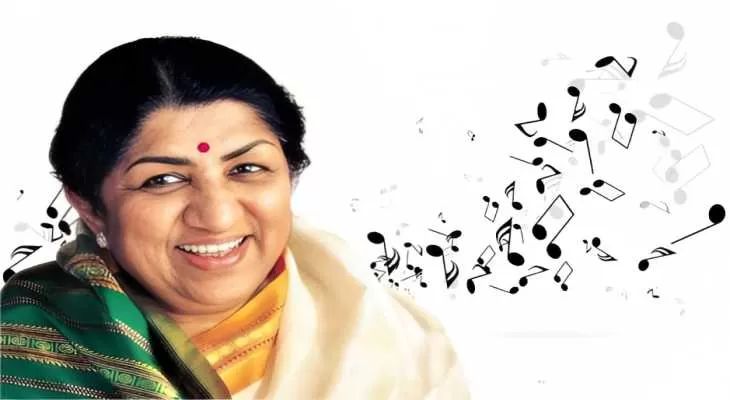
Lata Mangeshkar Biography – Life, Career, Songs, Awards & Legacy
 Jul 30, 2025 03:07
Lata Mangeshkar Biography – Life, Career, Songs, Awards & Legacy
Jul 30, 2025 03:07
Lata Mangeshkar Biography – Life, Career, Songs, Awards & Legacy
Jul 30, 2025 03:07