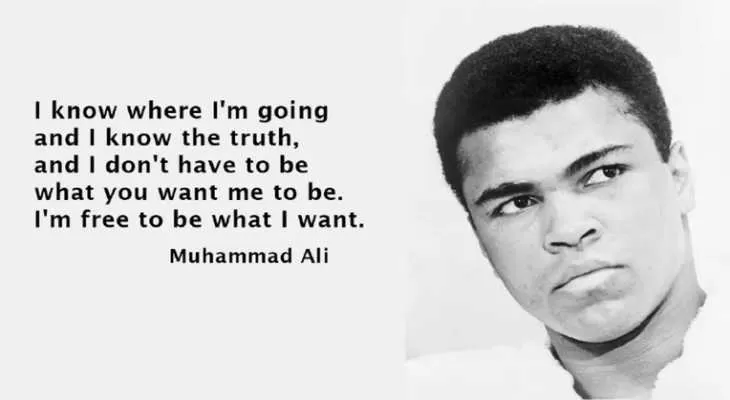

He was raised in a working class family the son of Cassius Clay Sr. a billboard painter, and Odessa Grady Clay, a domestic worker. Growing up in the segregated South young Cassius experienced racial prejudice early on, which shaped his outlook on life and justice.
At the age of 12 his life took a dramatic turn when his bicycle was stolen. Determined to fight the thief, he reported the incident to a police officer named Joe Martin, who was also a boxing coach. Martin suggested that Cassius should learn how to box before confronting anyone. These introductions sparked a life long passion eventually propelling him to global stardom.
Ali quickly displayed remarkable talent. By the time he was a teenager he had amassed numerous amateur titles. His dazzling foot work, lightning-fast reflexes, and unique fighting style distinguished him from others.
At just 18 years old Cassius Clay represented the United States in the 1960 Rome Olympics, where he won a gold medal in the light heavyweight division. This victory launched his professional career and established him as a rising star.
Ali turned professional shortly after the Olympics Between 1960 and 1963, he built an impressive record defeating seasoned opponents with flair and confidence. His unorthodox style, often keeping his hands low and relying on speed and movement, baffled traditional boxers. His famous slogan, “Float like a butterfly, sting like a bee”, perfectly captured his style.
In 1964, at the age of 22, Ali faced Sonny Liston, the reigning heavyweight champion.Few gave him a chance, but Ali shocked the world by dominating Liston, forcing him to quit after the sixth round. With this victory Ali became the world heavy weight champion
Shortly after his first world title Cassius Clay announced his conversion to Islam and changed his name to Muhammad Ali He joined the Nation of Islam under the guidance of Elijah Muhammad and Malcolm X. His decision was controversial but it marked a turning point in his life, both spiritually and socially.
Ali embraced his new identity with pride, rejecting his “slave name” and standing firm against criticism . This act symbolized his fight not only in the ring but also against racial injustice and inequality.
In 1967, at the height of his career, Ali refused to be drafted into the U.S. military during the Vietnam War, citing his religious beliefs and opposition to the conflict. His famous words echoed worldwide:
“I ain’t got no quarrel with them Viet Cong.”
This decision cost him dearly. Ali was stripped of his title, banned from boxing for nearly four years, and faced widespread condemnation. Yet, his courage in standing up for his beliefs elevated him as a symbol of resistance, integrity, and conviction.
Ali returned to boxing in 1970 but the sport had changed. Nevertheless, he quickly proved his resilience. His career in the 1970s included some of the most legendary bouts in history:
The Fight of the Century (1971): Against Joe Frazier at Madison Square Garden. Although Ali lost, the fight remains one of the most iconic in boxing history.
The Rumble in the Jungle (1974): Against George Foreman in Zaire.Using his clever “rope-a-dope” strategy Ali exhausted Foreman and won by knockout reclaiming the heavyweight title.
The Thrilla in Manila (1975): His third fight against Joe Frazier is considered one of the greatest fights ever. Ali won after Frazier’s corner stopped the fights after the 14th round.
These battles cemented Ali’s status as not just a champion but a deathless figure in boxing.
Ali continued to fight into the late 1970s and early 1980s. In 1978, he briefly lost his title to Leon Spinks but reclaimed it in their rematch becoming the first heavyweight to win the championship three times.
However, age and health began to take their toll. In 1981 after a loss to Trevor Berbick Ali retired with a professional record of 56 wins (37 by knockout) and 5 losses.
Beyond boxing, Muhammad Ali became a global ambassador for peace, justice, and humanitarian work. He traveled the world promoting good will aiding charities, and supporting causes such as racial equality, education, and hunger relief.
He married four times and had nine children, with his daughter Laila Ali also becoming a professional boxer. Despite personal struggles he remained dedicated to his family and faith.
In 1984 Ali was diagnosed with Parkinson’s disease, a neurological disorder believed to be linked to the punishment he took during his career. His illness slowed his movements and speech but it did not diminish his spirit. He continued making public appearances, including lighting the Olympic torch at the 1996 Atlanta Games, which became one of the most emotional moments in Olympic history.
Read also this : Dr. A.P.J. Abdul Kalam – Missile Man of India | Biography, Achievements & Legacy
Muhammad Ali passed away on June 3, 2016 at the age of 74 His death was mourned globally with tributes streaming in from world leaders, athletes and fans.
Ali’s legacy extends far beyond the boxing ring. He redefined what it means to be an athlete using his platform to challenge injustice, inspire millions and live by principles larger than sport. His charisma, wit, and courage made him a cultural icon recognized worldwide as “The Greatest.”
Muhammad Ali life was a "win" challenge and enduring impact He was more than a boxer he was a poet activist unselfish and symbols of courage From a young boy in Louisville to a three time heavy weight champion of the world Ali’s journey embodied resilience self belief and the relentless pursuit of justice
His refusal to compromise his principles even at the expense of his career, set him apart from other athletes. He stood against racism, resisted war and inspired generations to fight for what they believe in.
Ali once said: “Don’t count the days, make the days count.”
And indeed, Muhammad Ali made every day count leaving behind a legacy that continues to inspire the world.
In 1967, Muhammad Ali refused to go to the Vietnam war and was convicted of draft dodging and stripped of his world titles. Ali was vilified by the authorities and the media. But over time, they changed their minds about Ali and began to view him as a hero.
— James Melville ???? (@JamesMelville) August 22, 2024
Learn from history. pic.twitter.com/l3cqwMhmYg

Lata Mangeshkar Biography – Life, Career, Songs, Awards & Legacy
 Jul 30, 2025 03:07
Lata Mangeshkar Biography – Life, Career, Songs, Awards & Legacy
Jul 30, 2025 03:07
Lata Mangeshkar Biography – Life, Career, Songs, Awards & Legacy
Jul 30, 2025 03:07