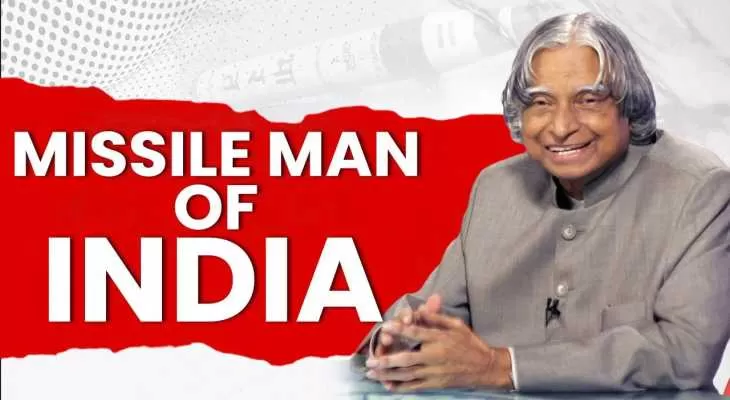

Dr. Avul Pakir Jainulabdeen Abdul Kalam, fondly thought of as the Missile Man of India was a visionary aerospace scientist, inspirational leader, and the 11th President of India (2002–2007). Known for his humility, simplicity, and dedication to science, education, and national development he played a pivotal role in India’s missile development and space research programs. His life story continues to inspire millions across the world.
Born: October 15, 1931 in Rameswaram, Tamil Nadu
Family Background: Humble origins, his father was a boat owner and his mother a home maker.
Education: After completing his schooling in Rameswaram Kalam pursued Physics at St. Joseph’s College, Tiruchirappalli, and later studied aerospace engineering at the Madras Institute of Technology (MIT)
His early struggles shaped his resilience and resolve, to serve the nation through science and innovation.
Dr. Kalam’s career began at the Defence Research and Developments company (DRDO) and later at the Indian Space Research Organisations (ISRO).
Satellite Launch Vehicle (SLV-III):Directed India’s first indigenous SLV project, which successfully deployed the Rohini satellite in 1980.
Integrated Guided Missile Development Program (IGMDP):Spearheaded India’s missile projects Agni, Prithvi, Akash, Trishul, and Nag.
Nuclear Tests: Played a crucial role in India’s Pokhran-II nuclear tests (1998), which traditional India as a nuclear power.
These achievements earned him the title Missile Man of India.
Elected as the 11th President of India, Dr. Kalam became the People’s President due to his approachable nature, inspirational speeches, and deep connection with students and youth.
Advocated for Vision 2020, aiming to transform India into a developed nation.
Focused on education, technology, and youth empowerment.
Remained a non-partisan leader, admired across political and social boundaries.
Bharat Ratna (1997) – India’s highest civilian award.
Padma Vibhushan (1990) and Padma Bhushan (1981).
Recognized globally for his contributions to science and leadership.
Dr. Kalam was a prolific writer, known for books that inspired generations:
Wings of Fire (Autobiography)
Ignited Minds
India 2020
The Life Tree
His writings emphasized innovation, spirituality, and national development.
Read this more : Bal Gangadhar Tilak: Revolutionary Leader in India's Fight for Independence
Even after completing his presidency, Dr. Kalam continued engaging with students, delivering lectures, and motivating the youth.
Advocated “Dream, Dream, Dream; Dreams transform into thoughts and thoughts result in action.”
Passed away on July 27, 2015, while delivering a lecture at IIM Shillong truly a man dedicated to knowledge until his last breath.
Dr. A.P.J. Abdul Kalam was not just a scientist or a President .He was a teacher, visionary, and role model. His contributions to India’s defense and space research, his dream of a developed India, and his inspiring personality have made him a global icon of knowledge, humility, and innovation. His life continues to motivate millions to pursue education, science, and service to society.
Remembering Dr. A.P.J. Abdul Kalam on his birth anniversary - a visionary, the people's president, a teacher, and the Missile Man of India.
— Narottam Sahoo (@narottamsahoo) July 27, 2025
His life reminds us: “Dreams transform into thoughts, and thoughts into actions.”
Let’s honour his legacy by igniting minds and shaping a… pic.twitter.com/F5PbHgLjRv

Lata Mangeshkar Biography – Life, Career, Songs, Awards & Legacy
 Jul 30, 2025 03:07
Lata Mangeshkar Biography – Life, Career, Songs, Awards & Legacy
Jul 30, 2025 03:07
Lata Mangeshkar Biography – Life, Career, Songs, Awards & Legacy
Jul 30, 2025 03:07