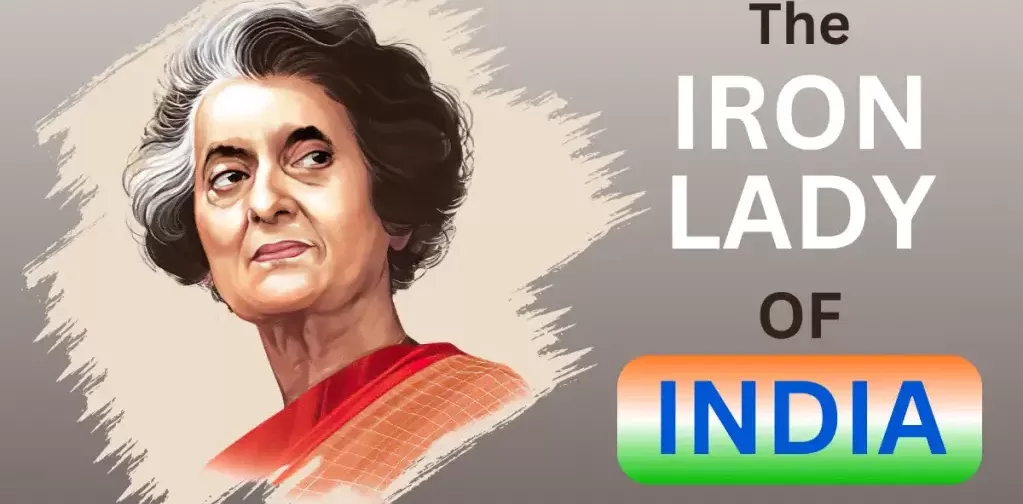

Indira Priyadarshini Gandhi was born on November 19, 1917, in Allahabad (now Prayagraj) India to Jawaharlal Nehru, the first Prime Minister of independent India and Kamala Nehru. She was the only child of the Nehru family. Her early years were marked by her father's frequent immurements and her mother's prolonged illness, leading to a somewhat solitary childhood.
Indira received her early education at home and attended various schools including the Modern School in Delhi St. Cecilia's and St. Mary's Convent schools in Allahabad, and the International School of Geneva. She later studied at Visva-Bharati University in Santiniketan and then at Somerville College, Oxford, where she pursued a degree in history. Her time at Oxford was important in shaping her political Knowledge.s.
Indira Gandhi's political journey began in the 1930s when she joined the Indian National Congress (INC). She played an important role in the party's activities and was appointed as the President of the INC in 1959. After the sudden demise of Prime Minister Lal Bahadur Shastri in 1966, Indira Gandhi was elected as the leader of the Congress Parliamentary Party and later became the Prime Minister of India on January 24, 1966.
Her ascent to power was seen as a surprise by many, as she was proportional inexperienced in politics compared to other senior leaders.but she quickly created herself as a powerful leader known for her resolution and strong will be .
1. Green Revolution
Indira Gandhi spearheaded the Green Revolutions in the late 1960s and early 1970s, introducing productive varieties of seeds, modern irrigation techniques and chemical fertilizers. This initiative transformed India from a food scarcity nation to one of the world's leading agricultural producers ensuring food security for millions.
2. Indo-Pakistani War of 1971 and Bangladesh Liberation
In 1971 India fought a decisive war against Pakistan leading to the creation of Bangladesh Indira Gandhi's leadership during this period earned her national and international acclaim. The victory hardened her image as a strong and successful leader.
3. Nuclear Program
Under her leadership India conducted its first successful nuclear test in 1974 at Pokhran codenamed "Smiling Buddha" This move founded India as a nuclear power and was an important climax in its defense capabilities.
4. Bank Nationalization
In 1969, Indira Gandhi state-owned 14 major commercial banks aiming to align the banking sectors with the needs of the poor and promote economic development. This policy expanded banking service to rural areas and facilitated greater access to credit for the needy sections of society.
5. Abolition of Privy Purse
In 1971, she abolished the privy purse the payments made to former rulers of princely states as part of her efforts to promote social equality and combine the princely states into the Indian Union.
Despite her achievements Indira Gandhi's tenure was also marked by controversies In 1975 following a court ruling that declared her election invalid she declared a state of emergency, suspending civil liberties and curbing press freedom. During this period thousands of political opponents were imprisoned and forced sterilization programs were executed The Emergency remains a contentious chapter in India's democratic history.
Read also this :Narendra Modi Biography: Life, Politics, Leadership, and Vision for India
Indira Gandhi received numerous accolades during her lifetime, including the Bharat Ratna, India's highest civilian award, in 1972. Posthumously, she was honored with the Lenin Peace Prize and the Bangladesh Freedom Honour for her role in the creation of Bangladesh.
Her legacy is remembered through various institutions and memorials, such as the Indira Gandhi International Airports in Delhi and the Indira Gandhi Memorial Trust Shakti Sthal her memorial in Delhi stands as a testament to her experience and influence on the nation.
Indira Gandhi married Feroze Gandhi in 1942, and the couple had two sons: Rajiv and Sanjay. After Feroze's death in 1960, Indira continued her political journey with her son Rajiv eventually advancing her as Prime Minister in 1984.
On October 31, 1984, Indira Gandhi was executed by her Sikh bodyguards in retaliation for Operation Blue Star, a military operation she ordered to remove Sikh militants from the Golden Temple in Amritsar Her death led to widespread anti-Sikh riots across the country.
Indira Gandhi's life and career were marked by significant achievements and arguments . She remains a polarizing figure in Indian politics respected for her leadership and criticized for her autocratic tendencies Her crash on India's political landscape is undeniable and her legacy continues to influence the nation's developments and democratic institutions.
Explore the extraordinary life of Indira Gandhi India’s first female Prime Minister and one of the most influential leaders in Indian history. From her early days in the Nehru household to leading the country through war, reforms, and emergency, her story is a powerful mix of… pic.twitter.com/yNgTCsdEZ1
— SA News Channel (@SatlokChannel) May 27, 2025

Lata Mangeshkar Biography – Life, Career, Songs, Awards & Legacy
 Jul 30, 2025 03:07
Lata Mangeshkar Biography – Life, Career, Songs, Awards & Legacy
Jul 30, 2025 03:07
Lata Mangeshkar Biography – Life, Career, Songs, Awards & Legacy
Jul 30, 2025 03:07