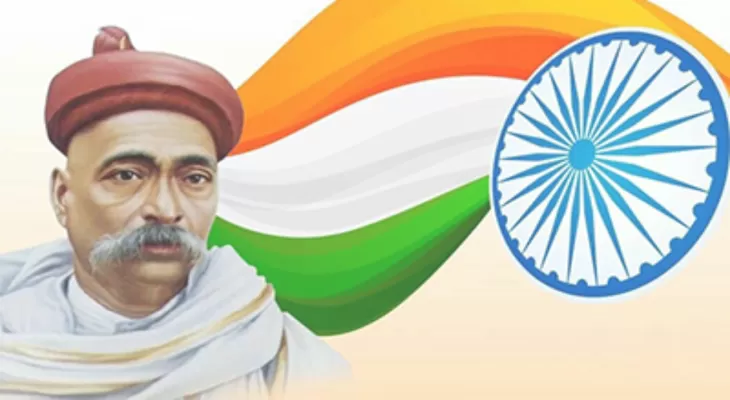

Bal Gangadhar Tilak was born to a middle-class Brahmin family. His father, Gangadhar Tilak, was a schoolteacher and a social reformer, which had an important influence on Bal Gangadhar. He was educated in Pune first at the local school and later at Deccan College where he studied mathematics and Sanskrit Tilak’s academic success, combined with his deep interest in Indian culture and history laid the foundation for his later complete activities.
Tilak entered the political scene when he founded the Deccan Education Society in 1884, along with his close associates including Laxmanrao Kirloskar, and Gopal Ganesh Agarkar. This corporation aimed to provide modern education to Indian students while also promoting nationalist ideas. During this period Tilak also began to write for various announcements, eventually becoming the editor of two influential Marathi newspapers: Kesari and Maratha. These newspapers became crucial platforms for the expressions of his views. Through them Tilak spoke out against British rule, called for self-rule and denounced the exploitations of India by the British. He also used his position as a writer to highlight the social issues affecting India such as the treatment of the Indian rank and file and the misuse of workers.
One of the most important aspects of Tilak's philosophy was his advocacy for Swaraj (self-rule) and his belief in achieving it through assertive and radical means. In contrast to the moderate views of other leaders like Dadabhai Naoro ji and Gopal Krishna Gokhale, Tilak called for direct action against the British, believing that India needed to break free from the shackles of colonial rule through self-support and nationalism .His famous slogan, "Swaraj is my birthright and I shall have it" encapsulated this sentiment
Tilak was one of the leaders of the extremist factions of the Indian Nationals Congress, a faction that believed in a more confrontational approach to British rule. His leadership in the Congress culminated in the formation of a new direction for the party, where the focus was more on mass mobilization and less on negotiation with the British government
In his quest for Swaraj Tilak argued that self-rule was essential for India’s progress. His argument was rooted in the idea that the British were exploiting India and had no interest in the welfare of the Indian people. Tilak believed that the Indian people had the capacity to govern themselves citing the rich cultural and historical traditions of India as evidence of its potential.
He took several bold steps to bring his vision to life. Among these was his enterprise to celebrate the festival of Ganesh Chaturthi publicly. This was seen as an attempt to bring people together, promoting a sense of unity and national consciousness. Through these public celebrations Tilak connected religion and politics, creating a platform for mass participation in the struggles for independence..
Tilak's idea of non-cooperation with the British government was revolutionary for its time. Unlike some of his contemporaries who believed in gradual reforms and cooperations with the British government, Tilak believed that only a complete boycott of British goods and services would force the British to leave India. He was one of the main architects of the boycott of foreign goods and the rejection of British laws. His belief in mass movements and the direct involvement of the common people in the struggle for freedom was a crucial step toward the larger mobilization of the Indian population against British rule.
Tilak was also a champion of Indian culture and religion. His work in reviving Hindu festivals such as Ganesh Chaturthi and Shivaji Jayanti was intended not only to bring people together for celebration but also to ignite a sense of national pride and unity among the masses. By incorporating local traditions into the national struggle for freedom, Tilak created a sense of cultural nationalism that resonated with millions of Indians.
In addition to promoting the cultural heritage of India, Tilak was also a scholar of Indian philosophy and history. His writings on the Vedas and the Gita helped revive interest in traditional Indian thought. His book The Arctic Home in the Vedas proposed that ancient Indian civilization was far older than Western scholars had previously believed. This work was one of the first to suggest that the origins of Indian culture could be traced back to the Arctic region, a controversial theory that later gained some traction among Indian nationalists.
In 1908, Tilak was arrested by the British for his involvement in the Lahore Conspiracy and sentenced to six years of imprisonment. He was sent to Mandalay in Burma (now Myanmar) where he spent several years in prison. During his imprisonment Tilak continued to write and correspond with his followers. His time in prison further solidified his reputation as a staunch nationalist and revolutionary
After his release in 1914 Tilak continued to play an active role in politics. He participated in the Home Rule Movement, led by Annie Besants which called for greater self government for India. Although he was not directly involved in the non-cooperation movement launched by Mahatma Gandhi Tilak's influence on the broader independence struggle remained indubitable
Bal Gangadhar Tilak's impact on India's fight for independence was immense. He is considered one of the key figures in the transformation of the Indian independence movement from a moderate to a more radical and mass based struggle His advocacy for Swaraj and his belief in the self reliance of the Indian people laid the foundation for the more assertive independence movements that followed including the movements led by Gandhi and Subhas Chandra Bose.
Tilak's work also had a lasting influence on Indian nationalisms and cultural pride. His efforts to promote Indian tradition and unite people across religious and social boundaries helped foster a sense of national identity that transcended regional and linguistic differences.
Bal Gangadhar Tilak remains one of the most respected figures in India history. His contributions to the freedom struggles, his advocacy for self-rule and his efforts to revive Indian culture make him a pivotal character in the narrative of India's path to independence. His legacy continues to inspire generations of Indians in their quest for justice, equality and freedom .
Read this more : Ashfaqulla Khan: Poet, Revolutionary, and Martyr of India’s Freedom Struggle
Swaraj:Self rule or self governance.
Kesari:A Marathi newspaper edited by Tilak which became an important tool in spreading nationalist ideas.
Ganesh Chaturthi: A festival celebrated by Tilak to unite peoples for a common cause.
Shivaji Jayanti: A day dedicated to the memory of Maratha king Shivaji promoted by Tilak to instill pride and nationalism.
Indian National Congress: The political party that played an important role in India's struggle for independence.
Home Rule Movement: A movement calling for greater self-governance for India led by Tilak and Annie Besant.
Lahore Conspiracy: A plot to assassinate a British official leading to Tilak’s arrest in 1908
Bal Gangadhar Tilak political ideology, his cultural nationalism and his radical approach towards the British colonial regime laid the groundwork for future leaders and movement in India journey towards freedom His contribution continues to be a guiding force for those committed to justice and self determination.
Bal Gangadhar Tilak, an extremely popular freedom fighter and one of the earliest leaders to demand Swaraj, or self-rule, was arrested on this date in 1908 for 'Sedition', for an article in defence of violent revolutionaries Prafulla Chaki & Khudiram Bose. Jinnah was his lawyer. pic.twitter.com/ob65bXjOLe
— Indian History Collective (@IndianHistory_C) July 3, 2021

Lata Mangeshkar Biography – Life, Career, Songs, Awards & Legacy
 Jul 30, 2025 03:07
Lata Mangeshkar Biography – Life, Career, Songs, Awards & Legacy
Jul 30, 2025 03:07
Lata Mangeshkar Biography – Life, Career, Songs, Awards & Legacy
Jul 30, 2025 03:07