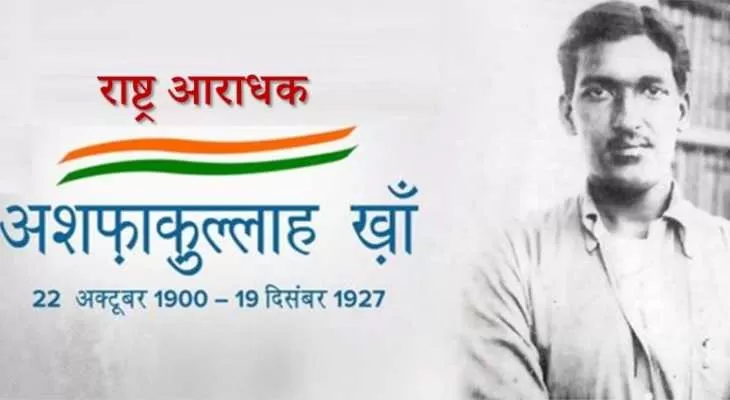

Ashfaqulla Khan (1900–1927) was a prominents freedom fighter and martyr of India’s struggle against British colonial rule. He co-founded the Hindustan Republican Association (HRA) later evolving into the Hindustan Socialist Republican Association (HSRA) aiming for an armed revolution and a federal republic founded on equality and justice He is especially remembered for his role in the Kakori Train Robbery and his unwavering sacrifice for independence.
Birth and Family
Born on 22 October 1900 in Shahjahanpur, Uttar Pradesh, Ashfaqulla was the youngest of six siblings in a Pathan family. His father, Shafiq Ullah Khan, came from a military background, while his mother, Mazharunissa, hailed from a lineage active in administrative roles under British rule.
Education and Introduction to Revolution
While still in school, he witnessed the arrest of Raja ram Bhartiya in the Mainpuri conspiracy case, which deeply affected him and fueled his revolutionary spirit. It was during this time that he came in contact with Ram Prasad Bismil, through his elder brother Riyasatullah, who was Bismil’s classmate. That meeting was foundational in forging Ashfaqulla’s path.
Friendship with Bismil and Literary Bonding
Bismil quickly became both mentor and friend. Ashfaqulla wrote Urdu poetry under pen names like Warsi and Hasrat, and Bismil appreciated and refined his poetic work. Their shared passion for poetry also served to solidify their revolution-bound friendship.
Disillusionment with Non-Cooperation
The Chauri Chaura incident in 1922 where 22 policemen were killed led Mahatma Gandhi to call off the lack of cooperation Movement. Many young Indians, including Ashfaqulla felt deeply disillusioned by this turn leading them to explore more radical forms of protest.
Founding the HRA/HSRA
Motivated by a vision of armed liberation Ashfaqulla and Bismil co-founded the Hindustan Republican Association, later the Hindustan Socialist Republican Association (HSRA). The HSRA advocated for a federal republic, universal suffrage, and the dismantling of systems that exploited people from landlords to capitalists.
Ideology and Vision
Ashfaqulla held firm beliefs in equality and communal harmony rejecting the communal politics of the British. He even wrote that freedom without equality would be meaningless. Once he was quoted expressing that if India attained independence but the poor remain oppressed, he'd rather not have that freedom.
Planning & Execution
In August 1925, facing a lack of funds for revolutionary activities, the HRA decided to rob a government treasury train near Kakori (on the LucknowShahjahanpur route). Initially hesitant, Ashfaqulla joined the operation out of commitment. On 9 August 1925, the train was successfully looted by Ashfaqulla Bismil Chandrashekhar Azad, Rajendra Lahiri and others.
Aftermath & Fugitive Life
The British retaliated swiftly. Bismil was arrested in October, while Ashfaqulla evaded capture, hiding in rural areas and even posing as a clerk. However his Pathan friend betrayed him leading to his arrest in December 1926 in Delhi. He was then transferred to Faizabad Jail.
The Trial: The trial in Lucknow lasted about a year. Despite being labeled “terrorists” by the British, Ashfaqulla and his comrades insisted their purpose was freedom, not terror. He famously stated that violence was a desperate method, not their goal.
Refusal to Betray: Authorities tried to convince him to testify against Bismil, painting communal overtones that Bismil wanted Hindu interests. Ashfaqulla refused to call Bismil more than a brother. His refusal was rooted in principle solidarity and belief in unity beyond religious lines.
Final Moments & Ideals
Sentenced to death, Ashfaqulla was executed by hanging at Faizabad Jail on 19 December 1927 alongside Bismil, Lahiri, and Roshan Singh His last words reflected deep patriotism asking for just a pinch of homeland soil as his shroud with poetry and courage flowing to the end:
“My hands are not soiled with the murder of man… God will give me justice.”
He chanted "La ilahi illallah, Muhammadur Rasool Allah" before his death, embodying dignity and unity.
Martyrdom & Symbolism
Ashfaqulla became a symbol of Hindu–Muslim unity and unwavering patriotism. He showed that identity could be transcended in the pursuit of a greater cause.
Cultural Depictions
His life has been depicted in popular culture:
Rang De Basanti (2006) — character inspired by his story, portrayed by Kunal Kapoor.
DD Urdu’s Mujahid‑E‑Azadi, and Star Bharat’s Chandrashekhar, further memorialize him.
Honors & Memorials
The Uttar Pradesh government named a zoological garden in Gorakhpur after him, in homage to his legacy.
Freedom fighter
Revolutionary
Hindustan Republican Association (HRA)
Hindustan Socialist Republican Association (HSRA)
Kakori Train Robbery
Shahjahanpur
Hindu–Muslim unity
Urdu poet, pseudonym Hasrat/Warsi
Martyrdom
Faizabad Jail
Equality & Social Justice
Armed revolution
Read also this : Bhagat Singh: The Revolutionary Icon of India
Ashfaqulla Khan’s life, though brief, blazed bright with ideals of liberty, equality, and communal harmony. Born into a conventional family, his journey from a young poet to a revolutionary icon reveals a profound evolution steered by injustice’s sight, poetic connection, and unshakeable friendship. He didn’t just oppose colonizers he opposed any form of oppression even if it stemmed from Indian elites.
The Kakori Train Robbery marked the crescendo of his valiant effort. Its boldness echoed larger refusals to accept subjugation. His resistance capture and refusal to betray comrades solidifieds him as a figure of collective dignity rather than isolated heroism.
That final moment in Faizabad Jail reciting his convictions with calm bravery summed his ethos succinctly Today Ashfaqulla Khan stands not as a divisive figure defined by religion but as a martyr of justice, unity and the profound sacrifice of youth for a greater cause. His story reminds us that courage isn’t limited by geography or creed; it's the universal language of freedom.
Ashfaqulla Khan was an Independence activist who was sentenced to death for being involved in the Kakori train robbery. We honour his bravery and remember his sacrifice for an Independent India. pic.twitter.com/rDba28loaL
— Congress (@INCIndia) December 19, 2018

Lata Mangeshkar Biography – Life, Career, Songs, Awards & Legacy
 Jul 30, 2025 03:07
Lata Mangeshkar Biography – Life, Career, Songs, Awards & Legacy
Jul 30, 2025 03:07
Lata Mangeshkar Biography – Life, Career, Songs, Awards & Legacy
Jul 30, 2025 03:07