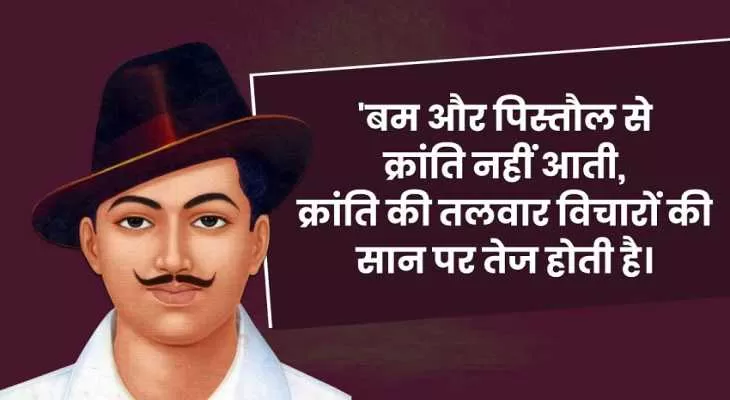

He was born in what is today Pakistan's Lyallpur district in Banga on September 28, 1907. Anti-British activism was not unknown in his household for a very long period. Both his father Kishan Singh, and his uncle, Ajit Singh, were vocal critics of colonial oppression as active participants in politics. Raised in such an environment meant Bhagat Singh had early exposure to nationalist ideologies at a young age.
From childhood, he showed a strong interest in freedom struggles. He was deeply moved by the Jallianwala Bagh massacre of 1919, where hundreds of unarmed Indians were killed by General Dyer. Singh, barely 12 years old, visited the site and collected soil from the ground, considering it sacred. This incident planted the seed of revolution in his mind.
Singh studied at Dayanand Anglo Vedic High School and later at National College, Lahore. Unlike many of his contemporaries, he was a voracious reader. He read extensively on European revolutionary movements, socialist literature and writings of leaders like Marx, Lenin, and Trotsky. These influences shaped his thinking beyond simple nationalism to revolutionary socialism.
According to him, not only should the British be thrown out of India, but a society free from exploitation, inequality, and communalism should also come into existence. That made him different from all other freedom strugglers.
He became affiliated with revolutionary organizations such as the Hindustan Republican Association (HRA), which would later be renamed Hindustan Socialist Republican Association (HSRA), at an early age. He quickly attained relevance in his life due to his leadership potential, enthusiasm, and quick thinking mind.
Then the British government formed the Simon Commission in 1928 for a discourse over constitutional reforms but without any Indian representation. As a result, there were huge demonstrations. When Lala Lajpat Rai was brutally lathi-charged by police in a procession at Lahore and later died, Bhagat Singh and his colleagues were angry.
To avenge Rai's killing, Bhagat Singh, in company with Rajguru, Sukhdev, and Chandrashekhar Azad, conspired to assassinate a police officer in vengeance, James Scott. But in confusion, they ended up killing a different officer, J.P. Saunders. That incident was a defining moment in Singh's revolutionary career and made Bhagat Singh a wanted man.
On 8 April 1929, Bhagat Singh and Batukeshwar Dutt hurled non-lethal bombs in Central Legislative Assembly in Delhi.Their intention was not to kill but "to make the deaf hear."They then hurled slogans of "Inquilab Zindabad" (Long Live the Revolution) and deliberately courted arrest. Singh made use of the court as a podium for propagating his revolutionary slogans.
During his imprisonment in Sarabha Nagar Jail, Bhagat Singh protested at the differential treatments meted out towards Indian prisoners in comparison with European prisoners. He jointly undertook a hunger strike in protest for better amenities like proper food, clothing, and reading materials. His resolve made a strong impression throughout the nation and he emerged as a hero in the minds of people.
He was not only a revolutionary stylist but a great thinker and columnist. Some of his works are:
"Why I am an Atheist" – an article in which he outlined his rejection of faith based dogma and stress on rationality.
Writings in Pratap and Kirti newspapers in which he criticized social discrimination, communalism, exploitation of farmers and labourers.
He envisioned socialist India where power would be in workers', farmers' hands. There was something more in his revolutionary thinking than resistance to the British; it was equality in society.
Bhagat Singh, along with Rajguru and Sukhdev, was tried in the Lahore Conspiracy Case for the killing of Saunders. Despite weak evidence, they were sentenced to death. Numerous appeals and mass protests were organized to save them, but the colonial government remained firm.
They were hanged on 23rd March 1931 in Lahore Jail. Singh was 23 when he was hanged. His hanging surprised the whole nation. These three are still considered Shaheed-e-Azam (Great Martyrs).
Legendary
Bhagat Singh’s sacrifice made him immortal in India’s history. He became a youth icon and inspired many to join the freedom struggle. Even leaders like Mahatma Gandhi and Jawaharlal Nehru, though differing in methods, acknowledged his bravery.
They are his living legacy in:
Youth Movements – Singh is a symbol for resistance and revolt for justice.
Slogans – "Inquilab Zindabad" still reverberate in political and social revolutions
Cultural Impact – There are thousands of publications, dramas, and films made dealing with his life, for example, Shaheed (1965), The Legend of Bhagat Singh (2002), and Rang De Basanti (2006).
Whereas most leaders had aspirations for political freedom only, Singh had more:
End of Exploitation - of workers, labourers, and peasants.
Communal Harmony- strongly opposed Hindu-Muslim divisions.
Scientific Thinking - He encouraged people to think with reason instead of blind faith.
Revolutionary Spirit - defying authority and advocating for justice.
His vision was not only a free India but a fair and equal India.
Read this more : Chandragupta Maurya – Founder of Mauryan Empire, Life, Achievements & Legacy
Bhagat Singh is still one of the most inspirational revolutionaries during the Indian freedom movement. His bravery, intelligence, and sacrifice made him a legend much ahead of his times. Though he had a life span of only 23 years, his thoughts still inspire justice movements, equality, and freedom forces around the globe.
He once stated: “They may kill me, but they cannot kill my ideas. They can crush my body, but they will not be able to crush my spirit.” This spirit of defiance ensures that Bhagat Singh’s legacy lives on eternally.
Tribute to legend bhagat Singh
— SANATAN (@Eternaldharma_) September 28, 2022
Bhagat Singh Life at JAIL
He was detained for two years, from April 8, 1929 to March 23, 1931, at the Lahore's Borstal Jail on charges of murdering British officer J P Saunders and throwing bombs in the Central Assembly. pic.twitter.com/QEeeKr7nfl

Lata Mangeshkar Biography – Life, Career, Songs, Awards & Legacy
 Jul 30, 2025 03:07
Lata Mangeshkar Biography – Life, Career, Songs, Awards & Legacy
Jul 30, 2025 03:07
Lata Mangeshkar Biography – Life, Career, Songs, Awards & Legacy
Jul 30, 2025 03:07