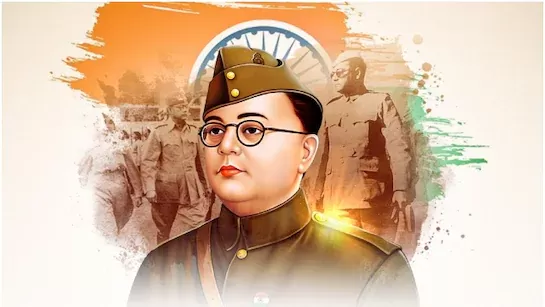

Subhas Chandra Bose, known as Netaji, was one of India’s bravest freedom fighters. His powerful speeches, strong ideals and unmatched courage inspired millions of Indians during the struggle for independence from British rules. While Mahatma Gandhi believed in non-violence, Bose followed a more aggressive path to freedom.
Let’s explore his life, from childhood to his mysterious death, his ideology, his thoughts, and why he remains a national hero to this day.
Subhas Chandra Bose was born on 23 January 1897 in Cuttack, a town in present-day Odisha His father Janakinath Bose, was a lawyer and his mother Prabhavati Devi. was
a devout and disciplined woman. Bose grew up in a large family with several siblings.
He was a brilliant student and completed his early education in Cuttack. Later, he joined Presidency College in Kolkata and later Scottish Church Colleges where he studied philosophy. His mind was sharp and he was deeply influenced by Swami Vivekananda’s teachings and Indian spirituality.
In 1919 Subhas went to England to prepare for the Indian Civil Services (ICS) exam. He passed with good marks but didn’t join the services. He felt that working for the British would be a betrayal of his country. Instead, he returned to India to join the national movement.
When he returned to India in 1921 he met Mahatma Gandhi and joined the Indian National Congress (INC). He was also close to C.R. Das, a respected freedom fighter who became his political mentor.
Bose became the Mayor of Calcutta in 1924 and later the General Secretary of the INC. However he was arrested by the British several times due to his bold statements and actions against British rule.
In 1930, during the Civil Disobedience Movement, he was imprisoned again. He was even kept in Mandalay Jail in Burma, which affected his health badly. After release, he was sent to Europe for medical treatment.
While recovering in Europe, Bose met many Indian students and political leaders living abroad. During this time, he wrote his famous book “The Indian Struggle,” which was banned by the British in India.
In Austria, he met Emilie Schenkl, who later became his wife. Together they had a daughter named Anita Bose Pfaff. However, this part of his life remained mostly private and was not discussed publicly by Bose.
Subhas Bose returned to India in 1936 and was warmly welcomed. He was again active in the Congress and was elected President of the Indian National Congress in 1938 and 1939. However, he soon faced disagreement with Gandhi and other senior leaders.
Bose believed in complete independence by any means necessary while Gandhi preferred non-violence and negotiations. Due to these differences, Bose resigned and formed a separate group called Forward Bloc.
The British were closely watching him, and he was put under house arrest in Kolkata In 1941 Bose made a daring escape in disguise, traveling through Afghanistan and the Soviet Union. Finally he reached Germany, where he sought help to fight the British.
He met Adolf Hitler, but their goals didn’t align completely. Bose’s main aim was to form a force of Indian soldiers who could fight the British alongside Axis powers.
In Germany, Bose started the Free India Center and launched a radio channel to connect with Indians. He also formed the Indian Legion from Indian prisoners of war. These efforts were aimed at building global support for India’s independence.
However, as World War II progressed, Germany’s role weakened. Bose realized Japan was gaining strength in Asia and decided to move there.
In 1943, Bose reached Japanese-controlled Southeast Asia, where he took charge of the Indian National Army (INA). The INA was initially started by Rash Behari Bose and Captain Mohan Singh, but under Netaji’s leadership, it became a major force.
With the motto "Give me blood, and I will give you freedom," Bose inspired thousands of Indian soldiers. The INA fought alongside Japanese forces in Burma and attempted to enter India through Imphal and Kohima.
Though the campaign failed due to strong British resistance and lack of support, Bose’s leadership brought pride and hope to Indians everywhere.
According to official reports, Subhas Chandra Bose died in a plane crash in Taipei on 18 August 1945. His body was reportedly cremated in Japan. However, his death remains one of the biggest mysteries in Indian history.
Many Indians believe he survived the crash and lived in hiding. Some claim he returned as a monk, while others suggest he was captured by the Soviet Union. The Indian government conducted several investigations, but no clear conclusion was ever reached.
Bose believed in strong leadership. He admired leaders like Hitler and Mussolini for their discipline and ability to mobilize nations. However, he did not support their cruelty. Bose wanted a strong and independent India, free from British rule and guided by one central authority to rebuild the nation quickly.
Though deeply spiritual, Bose kept religion out of politics. He believed in equality for all religions and wanted India to be a secular nation. He supported women's rights, labor welfare, and industrial development.
Some critics have accused Bose of aligning with Nazi Germany, a regime known for antisemitism. However, there is no clear evidence that Bose supported anti-Jewish ideology. His main purpose in collaborating with Axis powers was to gain freedom for India, not to support their internal policies.
“Give me blood, and I will give you freedom.”
A call to Indians to rise and fight for independence.
“It is blood alone that can pay the price of freedom.”
Shows his belief in sacrifice for the nation.
“One individual may die for an idea, but that idea will, after his death, incarnate itself in a thousand lives.”
“Freedom is not given, it is taken.”
Subhas Chandra Bose remains a symbol of bravery and patriotism. While his methods were different from Gandhi, both shared the same goal – an independent India.
The Indian National Army played a key role in inspiring Indian soldiers and people. After World War II, the INA trials stirred national emotions and increased pressure on the British to leave India.
In modern India:
Netaji’s birthday (23 January) is celebrated as “Parakram Diwas”.
His slogan “Jai Hind” is used by the Indian Armed Forces.
Many roads, airports, and institutions bear his name.
In 2022, a grand statue of Netaji was installed at India Gate in Delhi.
Bose was also a talented writer and thinker. His major works include:
The Indian Struggle (1934) Covers India’s political history from 1920 to 1934.
Letters to Emilie Schenkl Personal letters that show a different, softer side of Bose.
Speeches and writings on nationalism, military organization, and socialism.
The most inspiring thing about Netaji Subhas Chandra Bose was his fearless spirit. He didn’t wait for freedom to come; he went out and tried to get it by force, risking his life at every step. He united Indians across the world, gave a voice to Indian soldiers and proved that India had the strength to stand on its own.
His life teaches us about courage, sacrifice, and love for the nation. In a time when hope was low he gave India a reason to believe in its power.
Subhas Chandra Bose was not just a freedom fighter; he was a visionary leader who dreamed of a strong and united India. His efforts may not have directly resulted in independence, but they changed the way Indians saw themselves as bold, proud and ready to fight for their country.
Even after so many years, Netaji lives on in the hearts of millions. His life and message continue to inspire generations of Indians to serve the country with honesty, strength, and passion.

Lata Mangeshkar Biography – Life, Career, Songs, Awards & Legacy
 Jul 30, 2025 03:07
Lata Mangeshkar Biography – Life, Career, Songs, Awards & Legacy
Jul 30, 2025 03:07
Lata Mangeshkar Biography – Life, Career, Songs, Awards & Legacy
Jul 30, 2025 03:07