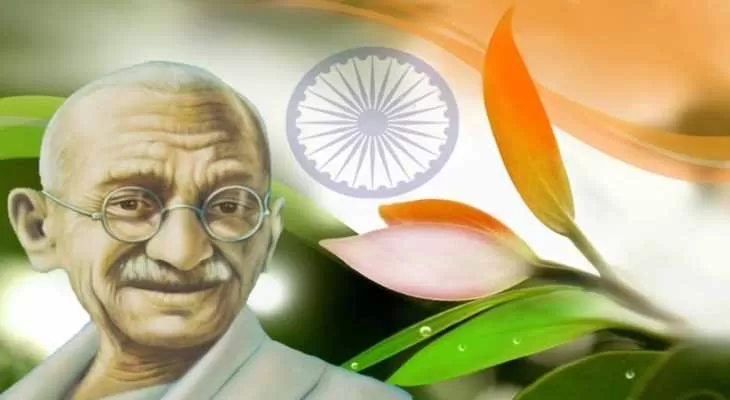

Gandhi was born into a Hindu Modh Bania family. His father was the diwan (chief minister) of Porbandar Gandhi was a quiet and serious child, deeply influenced by his mother’s devout religious beliefs and practices including fasting and nonviolence.
At 18 Gandhi traveled to London to study law at the Inner Temple. During his stay (1888–1891) he adopted Western customs but remained committed to Indian values. He returned to India in 1891 as a qualified advocate but fight
to organise a legal career in Bombay.
In 1893, Gandhi went to South Africa to work for a merchant firm. There he faced racial disadvantage
that deeply affected him. He organized the Indian community and developed his concept of Satyagraha (truth-force) leading nonviolent protests against unjust laws. He stayed in South Africa for 21 years fighting for civil rights and equality.
Gandhi returned to India in 1915. He traveled thoroughly to appreciate the country and its people. Guided by leaders like Gopal Krishna Gokhale, Gandhi emerged as a national leader in 1919 after the Jallianwala Bagh massacre. He led mass movements like. Non-Cooperation (1920), Salt March (1930), and Quit India (1942).
Gandhi is revered worldwide for his philosophy of nonviolence (Ahimsa) and truth (Satya). His methods inspired civil rights movements across the globe, including leaders like Martin Luther King Jr. and Nelson Mandela. He is widely regarded as the Father of the Nation in India.
Led India nonviolent independence movement.
Founded Satyagraha and promoted Ahimsa.
Mobilized millions across religious caste and class divisions.
Led India nonviolent independence movement.
Founded Satyagraha and promoted Ahimsa.
Mobilized millions across religious caste and class divisions.
Fought against unobtainable and promoted rural development.
Inspired global nonviolent resistance movements.
1869: Born in Porbandar.
1888: Sailed to London to study law.
1893: Moved to South Africa.
1915: Returned to India.
1919: Became prominent after Jallianwala Bagh.
1920: Launched Non Cooperation Movement.
1930: Led Salt March.
1942: Initiated Quit India Movement.
1947: India gained independence.
1948: Assassinated on January 30 by Nathuram Godse.
“Be the change that you wish to see in the world.”
“The best way to find yourself is to lose yourself in the service of others.”
“An eye for an eye only ends up making the whole world blind.”
“Live as if you were to die tomorrow. Learn as if you were to live forever.”
Autobiography: The Story of My Experiments with Truth
Biographies by Louis Fischer, Judith M. Brown
Articles from Britannica, Gandhi Heritage Portal, and Indian government archives.
He practiced vegetarianism and supported animal rights.
Gandhi’s birthday on October 2 is celebrated as Gandhi Jayanti in India and as International Day of NonViolence worldwide.
Though a Hindu, he respected all religions.
mentioned as “Bapu” (father) and “Mahatma” (great soul).
Gandhi was assassinated on January 30, 1948, in Delhi. He was shot by Nathuram Godse, a Hindu nationalist who opposed Gandhi’s inclusive and nonviolent politics. His death shocked the nation and the world leading to widespread mourning.
Mahatma Gandhi’s life was a beacon of truth, simplicity and service. Through peaceful resistance he reshaped India’s destiny and left a legacy that transcends borders. His ideals remain a guiding light for movements seeking justice and harmony.

Lata Mangeshkar Biography – Life, Career, Songs, Awards & Legacy
 Jul 30, 2025 03:07
Lata Mangeshkar Biography – Life, Career, Songs, Awards & Legacy
Jul 30, 2025 03:07
Lata Mangeshkar Biography – Life, Career, Songs, Awards & Legacy
Jul 30, 2025 03:07