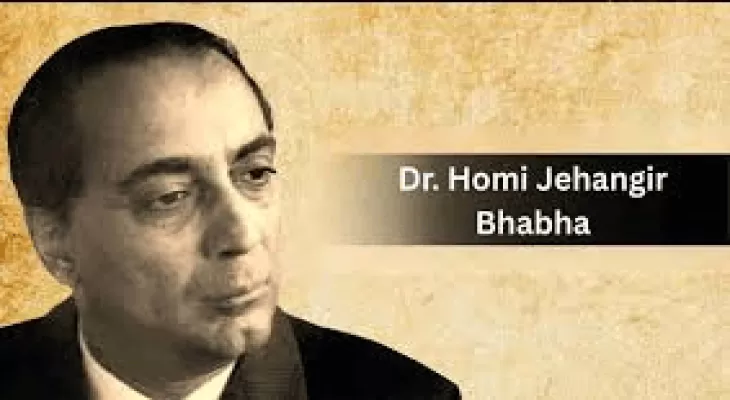

Dr. Homi Jehangir Bhabha (1909–1966) was one of India’s greatest scientific visionaries often remembered as the Father of the Indian Nuclear Program. A theoretical physicist of global repute, he combined exceptional scientific brilliance with organizational skills, institution building capability and a strong vision for India’s self-reliance in science and technology.
Born into a privileged Parsi family in Bombay, Bhabha was exposed to art, science and culture from a young age. His global education and exposure to eminent scientists helped him bring world class research methods to India . His leadership in creating organisations like The Tata Institute of basic Research (TIFR) and the Bhabha Atomic Research Centre (BARC) permanently shaped India’s scientific landscape.
Homi Jehangir Bhabha was born on 30 October 1909 in Bombay (now Mumbai) into a wealthy and influential Parsi family. His father Jehangir Hormusji Bhabha was a respected lawyer educated at Oxford, and his mother Meheren Bhabha came from a distinguished family with strong academic traditions
He began his schooling at Cathedral and John Connon School, one of Bombay’s premier institutions, known for its British style education. Bhabha was a bright student excelling in science and mathematics He then attended Elphinstone College and later the Royal Institute of Science, Bombay, before moving abroad for higher studies.
After completing his PHD, Bhabha worked at the Cavendish Laboratory in Cambridge, conducting ground breaking research in cosmic rays and electron-positron interactions. However, the outbreak of World War II in 1939 brought him back to India.
On his return, he joined the Indian Institute of Science (IISc) Bangalore, at the invitation of Nobel laureate C.V. Raman. At IISc he established the Cosmic Ray Research Unit and began nurturing young Indian scientists.
In 1945, with the support of the Tata Trust, Bhabha founded the Tata Institute of Fundamental Research (TIFR) in Bombay. TIFR became India’s leading center for advanced research in physics and mathematics.
played a major role in establishing the Bhabha Atomic Research Centre (BARC) at Trombay.
Scientific Contribution
Bhabha’s scientific achievements were recognized internationally. His most famous work, Bhabha Scattering, describes the interaction between electrons and positrons and remains a fundamental concept in particle physics. He also made important contributions to cosmic ray theory and quantum electrodynamics.
Bhabha published extensively in reputed journals and was respected for his ability to bridge theoretical concepts with experimental research. His work not only advanced science but also inspired young Indian physicists to aim for global standards.
Contribution to India’s Nuclear Program
Bhabha was the chief architect of India’s nuclear energy master mind . He envisioned nuclear energy as a tool for development and self reliance not merely as a weapon. He formulated India’s Three-Stage Nuclear Power Program, which aimed to use the country's abundant thorium reserves efficiently.
Asia’s first nuclear reactor Apsara went critical in 1956.
Research reactors like CIRUS and Dhruva were developed
India’s capability to design and construct nuclear reactors was established without over-reliance on foreign powers
Bhabha’s vision was to ensure that India would be among the leading nations in peaceful atomic energy applications while keeping open the option for strategic capabilities
Bhabha’s vision extended beyond nuclear energy He worked closely with Dr. Vikram Sarabhai, supporting the establishment of the Indian Space Research Program He understood the importance of satellite communication and remote sensing for India’s development
In electronics, he promoted the development of indigenous articles and computing technologies to support research and defense. He encouraged manufacturing
capabilities in advanced electronics, paving the way for India’s future technological self-reliance.
Awards and Recognition
Dr. Homi Bhabha’s work earned him national and international honors:
Fellow of the Royal Society (FRS) – 1941
Padma Bhushan – 1954
President, International Union of Pure and Applied Physics
Honorary doctorates from several universities worldwide
Leadership roles in the International Atomic Energy Agency (IAEA) conferences
Tragically, on 24 January 1966, Homi Bhabha died in the crash of Air India Flight 101 near Mont Blanc in the French Alps. The official cause was attributed to a navigational error. His sudden death at the age of 56 was a great loss to India’s scientific community and left several projects incomplete.
Dr. Homi Jehangir Bhabha was not only a brilliant scientist but also a nation-builder His foresight in nuclear energy space research and electronics positioned India on the global scientific map The institutions he created TIFR and BARC continue to drive India’s progress in research and innovation
His life teaches us the value of vision, leadership, and the resolve, to make a country self reliant in science and technology Even decades after his death Bhabha’s legacy continues to inspire generations of scientists and policymakers.
#ThisDayThatYear in 1909 marks the birth anniversary of the Father of Indian Nuclear Energy, Dr. Homi Jehangir Bhabha. #DidYouKnow India's atomic energy programme emerged from a partnership between him and JRD Tata? pic.twitter.com/dv92dzbWFW
— Tata Group (@TataCompanies) October 30, 2018

Lata Mangeshkar Biography – Life, Career, Songs, Awards & Legacy
 Jul 30, 2025 03:07
Lata Mangeshkar Biography – Life, Career, Songs, Awards & Legacy
Jul 30, 2025 03:07
Lata Mangeshkar Biography – Life, Career, Songs, Awards & Legacy
Jul 30, 2025 03:07