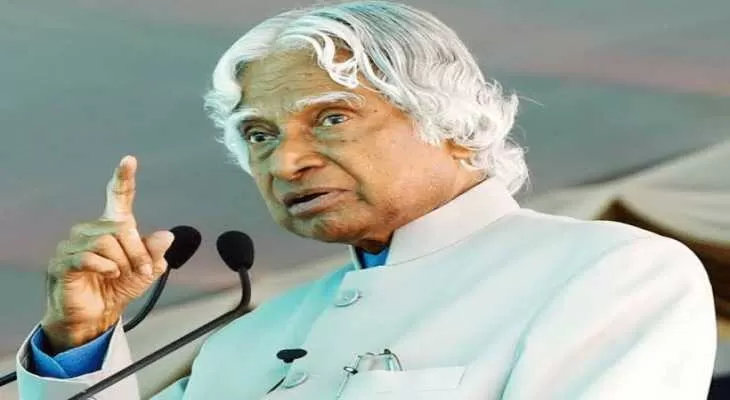

Avul Pakir Jainulabdeen Abdul Kalam was born on 15 October 1931 in Rameswaram Tamil Nadu, into a humble Tamil Muslim family. His father, Jainulabdeen, was a boat owner and imam, and his mother, Ashiamma, was a home maker. Despite financial hardship, Kalam was a bright, hard working student, deeply interested in science and mathematics. He studied physics at St. Joseph’s College, Tiruchirappalli, and later flying engineering at the Madras Institute of Technology (MIT).).
Kalam began his career at the Defence Research and Development Organisation (DRDO) in 1958 and later joined the Indian Space Research Organisation (ISRO) in 1969.At ISRO, he was instrumental in the developments of India’s first satellite launch vehicle (SLV-III) which successfully deployed the Rohini satellite in 1980. His passion for science and changes laid the foundations for India’s modern aerospace and defense programs
Dr. Kalam earned the nickname "Missile Man of India" for spearheading India's Integrated Guided Missile Developments Program (IGMDP). He played a pivotal role in the developments of Agni, Prithvi, Akash, Trishul, and Nag missiles. As the Chief Scientific Adviser to the Prime Ministers and Secretary of the DRDO Kalam transformed India into a self-reliant missile power.
Under his leadership India achieved significant breakthroughs in missile technology especially with the Agni series, which became a symbol of India's defense capabilities and technological strength. His work not only strengthened national security but also instilled confidence in India's scientific communities.
In 1998 Kalam was the chief project coordinator of Pokhran-II, a series of five nuclear bomb tests conducted by India in Rajasthan. These tests were conducted under the leadership of Prime Minister Atal Bihari Vajpayee and marked India's declaration as a nuclear weapons state.
Kalam’s role in the successful executions of the Pokhran tests elevated his national stature. His involvements in these critical events showcased his leadership in defense technology and his commitments to India’s master plan autonomy. Pokhran-II brought him immense public recognition turning him into a household name and national hero.
Dr. A.P.J. Abdul Kalam served as the 11th President of India from 2002 to 2007 becoming the first scientist and the first bachelors to occupy Rashtrapati Bhavan. He was elected with overwhelming support from all major political parties reflecting his non partisan appeal.
Known as the People’s President Kalam connected deeply with students, youth, and the common people. He advocated for education tools and youth empowerment, and used his presidency to inspire a new generation. He continued his scientific activities, encouraged electronic governance and remained accessible and humble throughout his tenure.
Although Kalam held one of the highest constitutional offices, he was not affiliated with any political party. He remained apolitical throughout his career, focusing on science, national developments and education. His presidency was marked by independence and integrity earning him cross party respect.
Post presidency he declined several political roles and returned to a life of teaching and public speaking. His dedication to nonpartisan services grand the office of the President and set a precedent for future leaders.
Dr. Kalam passed away on 27 July 2015 while delivering a lecture at the Indian Institute of Management Shillong, doing what he loved most inspiring studentsHis legacy lives on through his books, especially "Wings of Fire "Ignited Minds" and "India 2020", which continue to influence young minds.
His vision for a developed India, driven by science change, and education still resonates. The Kalam Effect his ability to connect with youth, dream big, and inspire action remains uniquemany organizations
scholarship and programs bear his name, including Dr. A.P.J. Abdul Kalam Technical University and Kalam Fellowships.
His life exemplifies the power of dreams, discipline, and dedication. Revered as the Missile Man, a visionary, and the People’s President, A.P.J. Abdul Kalam is placed as one of India’s greatest sons whose impact will guide generations to come.

Lata Mangeshkar Biography – Life, Career, Songs, Awards & Legacy
 Jul 30, 2025 03:07
Lata Mangeshkar Biography – Life, Career, Songs, Awards & Legacy
Jul 30, 2025 03:07
Lata Mangeshkar Biography – Life, Career, Songs, Awards & Legacy
Jul 30, 2025 03:07